ElevenLabs AI Voice Agent Review: Pricing, Features, Alternatives
TL;DR
-
What is ElevenLabs AI? ElevenLabs is an AI audio platform best known for hyper-realistic text-to-speech and voice cloning. Its voice agent product (now part of “ElevenAgents”) lets developers build conversational AI for phone, web, and messaging.
-
Pricing: Free tier with ~10 minutes/month; paid plans run from $5/month (Starter) to $825/month (Business), with custom Enterprise pricing. Voice agent minutes typically bill at $0.08–$0.10/min after quota.
-
Strengths: Industry-leading voice realism, 70+ language coverage, fast latency, deep developer tooling.
-
Weak spots: Credits burn fast, billing rollover is limited, customer service automation is thin, and integrating with existing call center tooling takes engineering work.
-
Best alternative for business communication: CloudTalk – purpose-built for sales and support teams that need AI voice agents plus a real phone system, CRM integrations, and call center workflows out of the box.
ElevenLabs has spent the last few years setting the bar for AI-generated voices. The natural intonation, emotional range, and multilingual reach made it the go-to choice for creators, podcasters, developers, and teams building virtual assistants. In 2025 and 2026, the company pushed harder into conversational AI with its voice agent platform – squarely targeting the same buyers who already shop tools like Vapi, Retell, and traditional call center vendors.
That shift raises an obvious question: is the ElevenLabs AI voice agent actually a fit for business customer service, or is it a developer toolkit dressed up for a different use case?
This review breaks down the ElevenLabs voice agent platform across pricing, features, real user feedback, and the strongest alternative options if you decide it isn’t the right fit. By the end, you’ll know whether ElevenLabs belongs in your stack – and what to look at next if it doesn’t.
What is ElevenLabs AI Voice Agent?
ElevenLabs is an AI audio company founded in 2022 and headquartered in New York and London. The company first made waves with its lifelike text-to-speech engine and voice cloning capabilities, which quickly became favorites for audiobook narration, dubbing, game development, and content creation.
In 2024 the company introduced Conversational AI – a managed platform for building voice agents that can hold real-time conversations. By 2026 this offering had evolved into “ElevenAgents,” a complete platform for deploying emotionally intelligent voice agents across phone (via Twilio and similar carriers), WhatsApp, and embedded web chat. The elevenlabs conversational AI voice agent stack is part of a broader product trifecta: ElevenAgents for conversational AI, ElevenCreative for voice and media generation, and ElevenAPI for the developer-facing infrastructure.
The pitch is simple: pair the best-sounding voices on the market with a managed conversational layer so developers can create and deploy AI agents more quickly.
How the ElevenLabs voice agent works
Under the hood, the ElevenLabs AI voice agent stitches together four pieces:
-
01
Speech-to-text (Scribe v2) transcribes the caller’s audio in real time, handling noisy environments and varied accents.
-
02
A turn-taking model detects conversational cues like “um,” pauses, and breath sounds, so the agent knows when to listen and when to respond. This is the upgrade that ElevenLabs shipped with Conversational AI 2.0 and refined again in early 2026.
-
03
An LLM brain generates the response. You can use ElevenLabs’ managed models or bring your own via the Voice Engine path, which exposes the same SDK but lets you plug in your own model, RAG layer, and business logic.
-
04
Text-to-speech (TTS) synthesis turns the response into audio using the v3 voice model, which supports 70+ languages and a community library of 5,000+ voices.
Latency sits in the sub-second range for the Flash model, which is what most production voice agents use. Retrieval-Augmented Generation (RAG) is baked directly into the architecture, so agents can pull from your knowledge base without bolting on external infrastructure. Voice integration typically requires a voice ID and API key. Recent updates added Git-style branching for agent versions and stronger safety guardrails – useful when you’re deploying into regulated workflows.
For teams just exploring this space, our guide on how to implement an AI voice agent in your business walks through the practical setup steps regardless of which platform you choose.
See a voice agent that’s built for sales and support
What Are the Key Features of ElevenLabs Voice Agent?
The ElevenLabs voice agent features cover most of what you’d expect from a modern conversational AI stack, plus a few that are genuinely best-in-class.
Text-to-speech and Voice Library
The voice library is the heart of the platform. ElevenLabs offers a community library of thousands of voices in 70+ languages, plus its proprietary v3 model for the most expressive output. Voices respond to in-line tags for emphasis, pace, and emotion, which is why content creators consistently rate the output as the most natural on the market.
Customization options let teams create a custom voice or tune stability and clarity per voice, and you can pin specific voices to specific agent flows for more human-like responses.
AI Voice Cloning
Two cloning paths exist: Instant Voice Cloning (a minute or two of clean reference audio) and Professional Voice Cloning (30+ minutes of studio-quality audio for the closest possible match). You can clone a voice from reference samples and use the clone across projects like narration or podcasts.
Both are gated to paid tiers, with Professional Voice Cloning available from the Creator plan and up. Cloned voices can be used inside agent flows the same way as any library voice, which makes it easy to give your agent a consistent brand identity.
Multilingual Support and Dubbing
The platform supports speech generation across 70+ languages, with automatic language detection inside Conversational AI 2.0. That means a single agent can switch languages mid-call based on what the caller speaks – no manual routing required.
The dubbing feature, refined in 2026, now carries the speaker’s emotion and performance across languages. Note that dubbing burns through character credits quickly, so it’s worth modeling expected usage before committing to a tier.
Real-time Conversational AI
The ElevenLabs voice agent platform handles full-duplex conversation with sub-second latency on the Flash model, making complex two-way interaction possible. The turn-taking system has been the most-mentioned improvement of the last 18 months.
With natural language processing, agents no longer talk over callers, and they respond appropriately to “let me think for a second” kinds of pauses. For developers, this means the conversational layer feels closer to a human than what most competitors can deliver, including more natural spoken responses.
API and Developer Integration
ElevenLabs is a developer-first platform, and developers can integrate it with other platforms and apps via the API. Python and TypeScript SDKs, streaming endpoints, webhook support for tool calls, and a Conversation SDK for embedding agents directly into web and mobile apps.
There are two main paths: the Agents Platform (fully managed, lowest latency, dashboard for non-developers) or the Voice Engine (bring your own LLM, RAG, and orchestration).
Telephony integration runs through Twilio for phone calls, plus native support for WhatsApp Business, and call routing optimizes incoming calls to designated agents or departments. In embedded experiences, voice features often turn text input into spoken replies.
If you’re shopping voice AI specifically for outbound use cases, our guide to the best automated voice agents for lead generation is worth a read alongside this review.
4.6 Data Privacy, Security and Compliance
ElevenLabs supports SOC 2, GDPR, and HIPAA compliance on the Enterprise tier, with SSO, BAAs, and dedicated support. Standard plans get baseline data protection but not the formal certifications that regulated industries need. Conversation logs and audio are stored for monitoring and improvement; you can configure retention and opt out of certain data uses on paid tiers.
For a deeper look at this category of risk, see our piece on how secure data is when using voice AI.
Want to test a business-ready voice agent yourself?
How Much Does ElevenLabs Voice Agent Cost?
ElevenLabs uses a credit-based system layered on top of seven pricing tiers. Credits map to characters of synthesized speech; for the voice agent, what matters most is the per-minute conversation cost once you’re past your bundled minutes.
Here’s a quick comparison of the elevenlabs voice agent pricing tiers, current as of 2026:
Agent minutes are approximate because credits also fund TTS, dubbing, music, and voice design – so heavy use of those features will reduce what’s left for your voice agent. Overage rates run roughly $0.08–$0.10/minute depending on tier.
Free plan
10,000 credits per month, which works out to about 10 minutes of high-quality TTS or roughly 15 minutes of conversational AI. You get access to text-to-speech, speech-to-text, sound effects, voice design, music, and three Studio projects. No commercial rights – anything you generate is for personal evaluation only. This is the sandbox tier, not a production option.
Starter plan ($5/month)
The Starter plan unlocks commercial rights and bumps your credit allowance to ~30,000 credits/month (about 50 minutes of agent time). Professional Voice Cloning is still locked out at this tier. Useful for indie developers who want to ship something small and personal, or for testing with real users before committing more budget.
Creator plan ($18.3/month)
100,000 credits/month – enough for roughly 250 minutes of agent conversation, or 100+ minutes of v3 TTS output. You unlock Professional Voice Cloning, higher quality settings, and faster generation. This is the tier most podcasters, YouTubers, and small content shops live on. Note the brief mentions $11/month for this plan; ElevenLabs updated the price to $22/month, which is the figure you’ll see on the live pricing page.
Pro plan ($82.5/month)
500,000 credits/month, about 1,100 minutes of agent time. Includes 44.1 kHz PCM audio output, higher concurrency limits, and analytics for usage monitoring. This is the smallest tier a business owner will usually consider for production use, since the Creator tier runs out of credits quickly once a voice agent goes live.
Scale plan ($249/month)
2,000,000 credits/month, ~3,600 minutes of agent time. Higher concurrency limits, better SLAs, and access to features like increased character limits for long-form generation. This is the plan most production voice apps end up on once they have steady traffic.
Business and Enterprise plans
The Business tier costs $825/month and includes 11,000,000 credits – enough for roughly 13,750 minutes of conversation, multi-seat workspaces, and Professional Voice Cloning across the organization. Enterprise pricing is custom and adds SSO, HIPAA/BAA compliance, dedicated support, and volume discounts.
The biggest user complaint here is credit burn: agents that handle long calls or use the more expensive Multilingual v2 model can chew through quota faster than expected. Credits do roll over on paid plans, but only for two billing cycles – they don’t accumulate indefinitely. Many teams hit overage charges in their second or third month after deploying.
For an apples-to-apples breakdown of how this compares to other vendors, see our AI voice agents research and reports hub.
What Do Real Users Say About ElevenLabs AI Voice Agent?
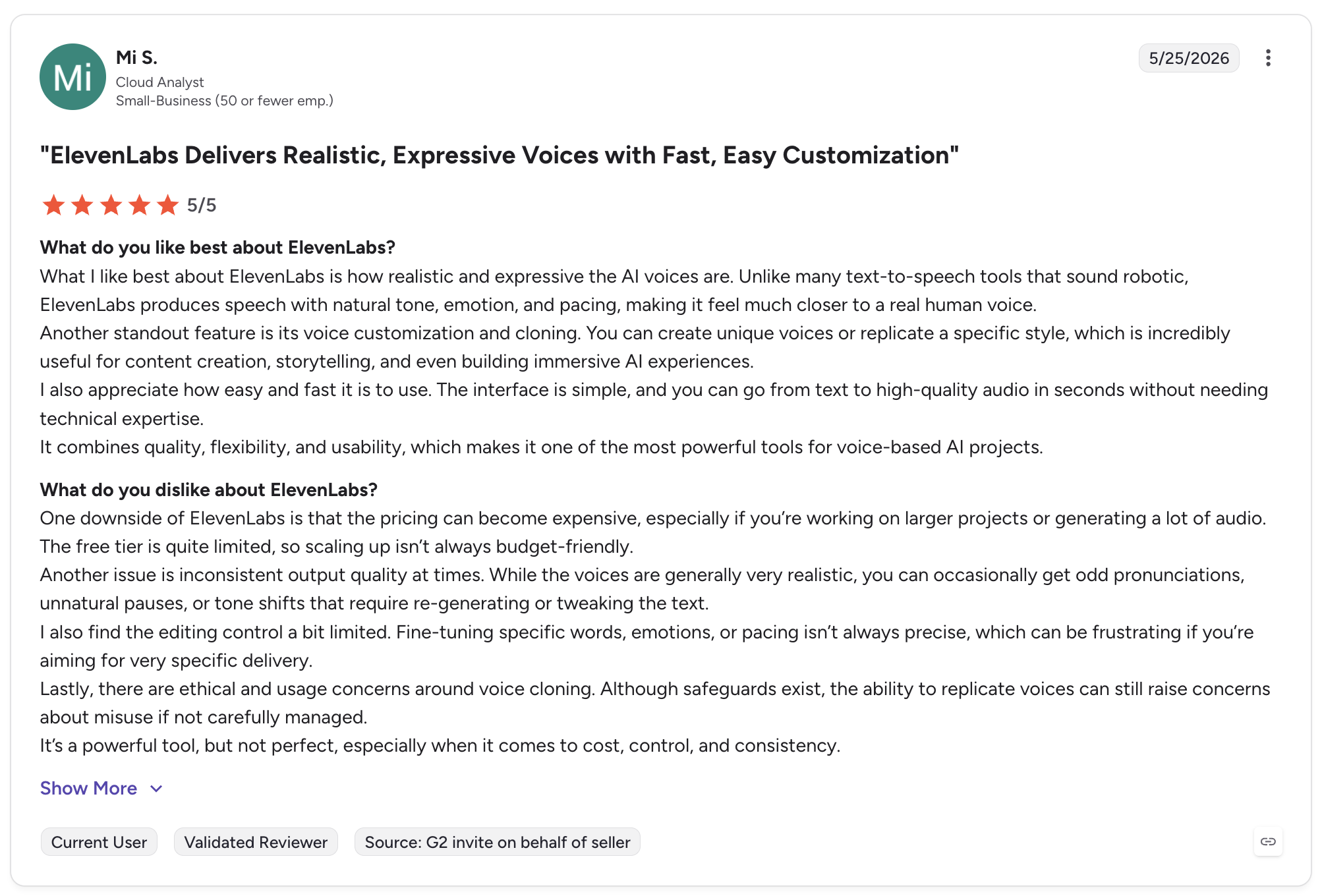
Sentiment on ElevenLabs is mixed and varies sharply by use case. G2 reviewers tend toward enthusiastic – most ratings sit in the 4.5+ range and praise the voice quality and ease of use. Trustpilot tells a different story, with an average score around 3.2 and a heavy concentration of complaints about billing and customer service. Reddit and Quora threads echo both sides.
Common praise from users
-
Voice realism is unmatched. A common refrain across G2 and Trustpilot is that the voices sound genuinely human, with natural emphasis and emotional range. One verified reviewer wrote that the platform delivers “incredibly realistic and natural-sounding voices” with “emotional depth and rhythm” that make their content “far more engaging than other text-to-speech tools.”
-
Speed to deployment. Multiple reviewers note that a working voice agent can be deployed in under 30 minutes, especially when using the managed Agents Platform. One Trustpilot reviewer described being able to “deploy a functional conversational AI agent in under 30 minutes.” That also helps teams move beyond traditional chatbots and their typed back-and-forth.
-
Multilingual coverage that actually works. Users running global content or international agents call out the 70+ language support and automatic language detection as a clear differentiator over competitors that only do English well.
-
Strong support when you reach them. When support does respond, reviewers describe the interactions as detailed and genuinely helpful rather than canned. The grant program for early-stage developers also gets repeat positive mentions.
Common complaints from users
-
Credit consumption is faster than expected. This is the single most common complaint. One Trustpilot reviewer who upgraded all the way to the $330/month Scale plan said they could only generate “a few chapters of audio” from an audiobook before running out of credits. The same pattern shows up for voice agents – long calls drain credits quickly, and overage charges can surprise teams in their first quarter.
-
Billing and refund frustrations. Several reviewers report that canceled subscriptions resulted in remaining credits being clawed back, which they describe as bad customer management. Misleading pricing perception is a recurring theme: users expect more minutes than they actually get on lower tiers.
-
Inconsistent audio quality at the edges. A small but vocal group of users report intonation drops at the end of sentences, glitches in long-form generation, and accent rendering that misses on certain dialects. One reviewer estimated “a 50% loss in intonation” on some outputs.
-
Limited customer service automation features. This is where customer support teams and customers feel the gap most clearly. ElevenLabs gives you a powerful conversational engine, but it’s not a call center platform. There’s no native ticketing, no CRM sync out of the box, no agent supervision tooling, and no built-in reporting for customer service KPIs. Teams trying to use it for support quickly hit this wall.
-
WhatsApp and integration friction. Several recent reviews flag specific integration issues – for example, WhatsApp setup getting stuck in Meta’s auth flow with limited support responsiveness.
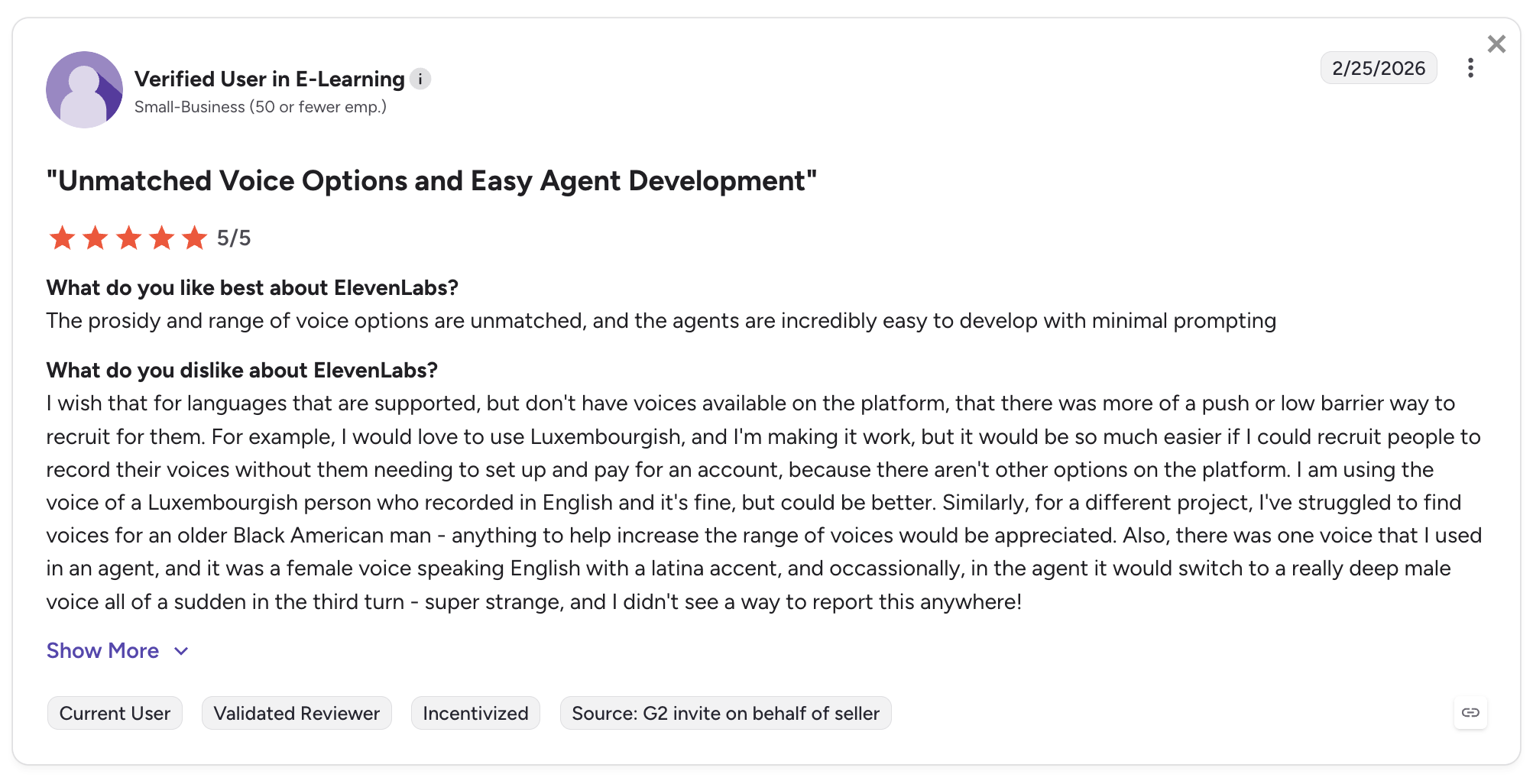
For an industry-curated take, our list of the best AI voice agents in 2026 provides additional context on how ElevenLabs ranks across customer service-specific criteria.
What Are ElevenLabs Voice Agent’s Pros and Cons?
Advantages
-
Best-in-class voice realism. v3 voices with emotional range, in-line emphasis tags, and 70+ language coverage. If voice quality is your top criterion, very little on the market matches it.
-
Massive voice library. Thousands of community voices plus instant and professional cloning. You can hit almost any tone, accent, or persona without commissioning custom work.
-
Fast latency for real-time conversation. Sub-second response times on the Flash model, with a turn-taking system that handles natural pauses and interruptions far better than older systems.
-
Developer-friendly platform. Python and TypeScript SDKs, streaming endpoints, RAG built into the agent architecture, and two clear paths (Agents Platform vs. Voice Engine) depending on how much control you want.
-
Pay-as-you-go flexibility with annual savings. Annual billing saves roughly 17%, and you can pause or downshift plans if usage drops.
Disadvantages
-
Credits burn faster than you expect. This is the dominant complaint across reviews. Voice agent minutes consume credits quickly, and rollover only covers two billing cycles.
-
Not a call center platform. No native CRM sync, no ticketing, no real-time agent supervision tools, and limited reporting for customer service KPIs. Teams trying to replace a support stack end up bolting tools together.
-
Inconsistent audio quality on edge cases. Intonation drops at sentence endings, occasional glitches on long-form output, and accent rendering misses on certain dialects.
-
Billing and customer service frustrations. Clawback of unused credits on cancellation, slow support response on integration issues, and pricing that some users describe as misleading on lower tiers.
-
Shallow integration with helpdesk and call center tooling. Twilio works for phone routing, but native integrations with Zendesk, Salesforce, HubSpot, or Intercom require engineering effort rather than configuration.
For a head-to-head with voice AI built specifically for customer service, the contrast becomes obvious very quickly.
See a voice agent that ships with CRM, reporting, and support workflows built in
5 Best ElevenLabs Voice Agent Alternatives in 2026
If ElevenLabs isn’t quite right for your use case – especially if you need a business phone system rather than a developer toolkit – here are the five strongest alternatives in 2026.
1. CloudTalk: Best for business voice communication
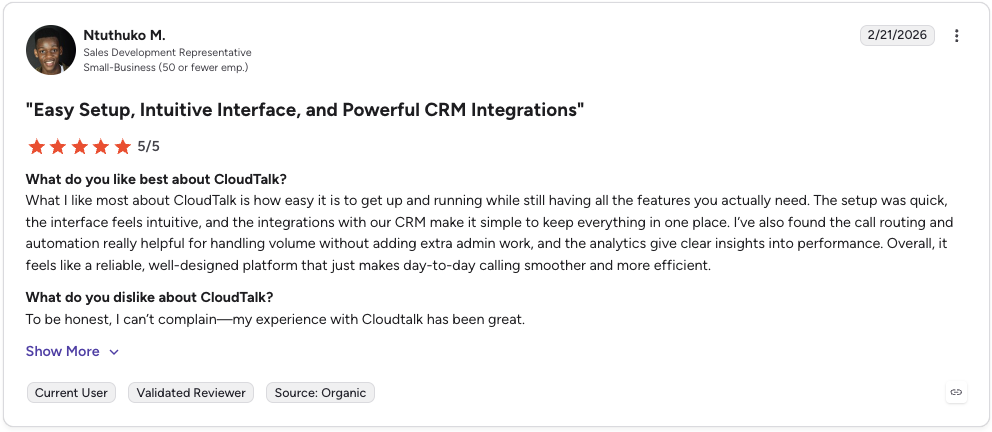
CloudTalk is purpose-built for what most businesses actually want when they shop “AI voice agent” – a phone system that handles real customer calls, plus AI that automates routine interactions for better customer outcomes. Where ElevenLabs gives you a developer toolkit and asks you to assemble the rest, CloudTalk gives teams an easier way to deploy AI agents with the call center, the CRM integrations, and the AI agent in a single platform.
What Are CloudTalk’s Best Features?
-
Local Numbers in 160+ Countries — Call from a local number anywhere in the world. Prospects see a familiar caller ID, lifting answer rates by up to 40%.
-
AI Sales Dialer with Parallel Dialing — Dial up to 10 lines at once and connect instantly with the first live answer. Reps spend their time talking, not dialing.
-
Voicemail Drop & Answering Machine Detection — Skip unanswered calls automatically or leave a pre-recorded message in one click, saving hours of talk time every day.
-
Drag-and-Drop Call Flow Designer with IVR — Route every caller to the right agent on the first try with custom menus and smart routing — no transfers, no hold-time frustration.
-
AI Notes Synced to Your CRM — Every call is transcribed, summarized, and logged in HubSpot, Salesforce, or Pipedrive automatically. Manual data entry disappears.
-
Real-Time Monitoring — Watch live dashboards and coach agents mid-call without the customer hearing a word.
-
24/7 AI Voice Agents — Automate routine calls like appointment booking and lead qualification around the clock, with seamless handoff to a human when it matters.
Who is CloudTalk Best for?
For sales teams, support teams, and any business where the agent is one part of a broader call workflow, CloudTalk is the clearer choice. ElevenLabs wins on voice realism in absolute terms; CloudTalk wins because everything else around the voice agent is already built.
What Are G2 Users Rating CloudTalk?
CloudTalk is rated 4.4/5 by 1,700+ verified users on G2.
2. Play.ht: Best for customizable speech synthesis
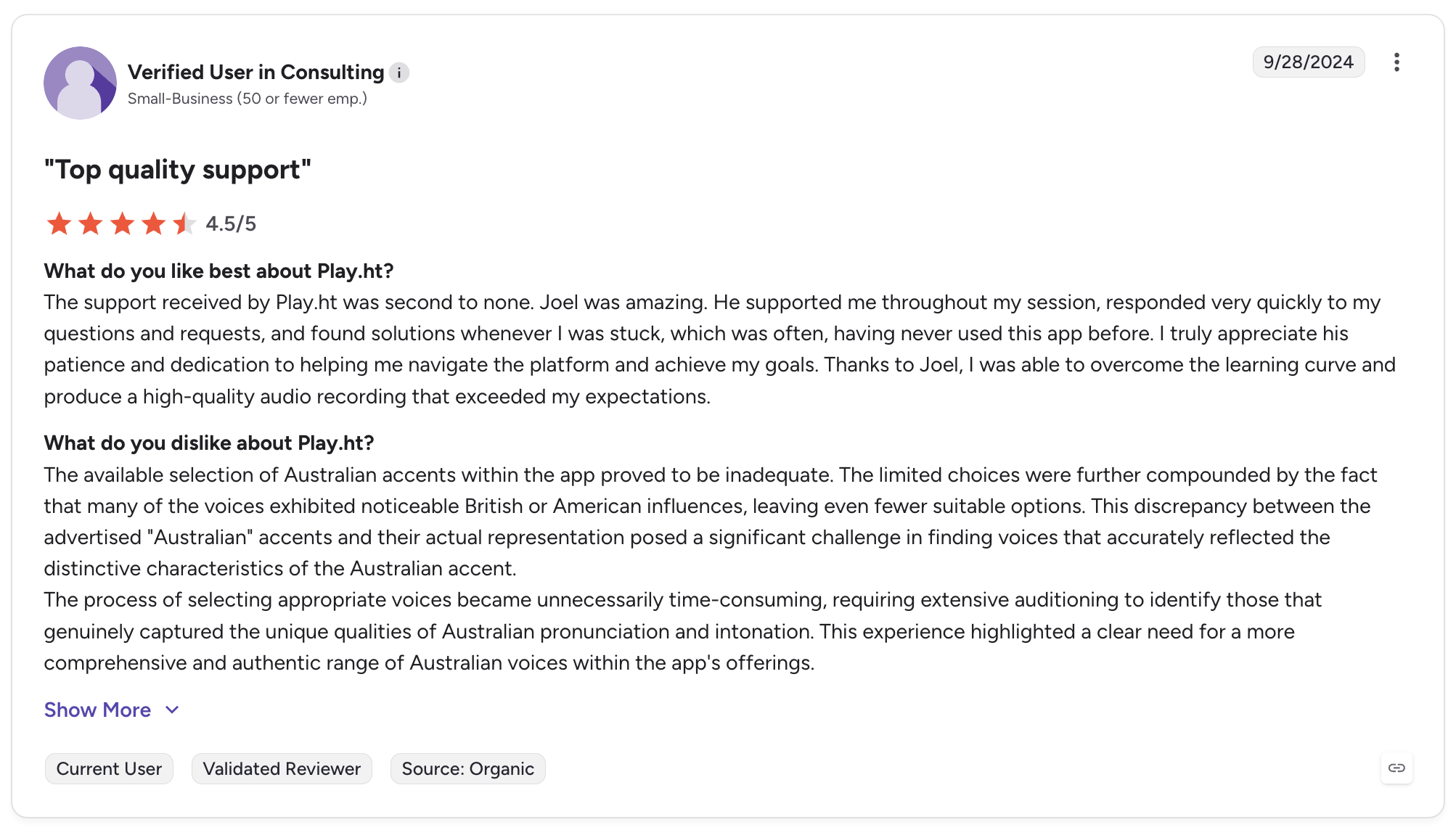
Play.ht offers 800+ AI voices across 100+ languages, with deep SSML customization for fine-grained control over pronunciation, pauses, and emphasis. It exports downloadable MP3 and WAV files, which makes it a strong choice for podcasters, video creators, and audiobook producers who want offline editing rather than a streaming API. Its conversational AI offering is newer and less mature than ElevenLabs’, but its TTS library is competitive.
What Are Play.ht’s Best Features?
-
800+ AI voices across 100+ languages, with customization of tone, pitch, speed, emphasis, and pauses via deep SSML support.
-
Downloadable MP3 and WAV exports for offline editing workflows.
-
Voice cloning from short audio samples, plus a real-time streaming API with WebSocket support for developers.
-
Built-in podcast hosting and distribution, plus natural pacing on long-form content, making it popular for audiobook production and blog-to-audio conversion.
-
Accessible pricing: a free plan with 12,500 characters per month, with paid plans starting at $39/month.
Who is Play.ht Best for?
Play.ht is best for podcasters, audiobook producers, and video creators who need granular control over how their audio sounds – and who prefer downloading finished files over wiring up a real-time agent. If your workflow is “write script, generate audio, edit offline, publish,” Play.ht covers it at a lower cost than agent-first platforms. It’s not the pick if you need mature conversational AI; that’s where ElevenLabs and CloudTalk pull ahead.
What Are G2 Users Rating Play.ht?
Play.ht is rated 4.2/5 by verified users on G2.
3. Descript: Best for podcast and video editing
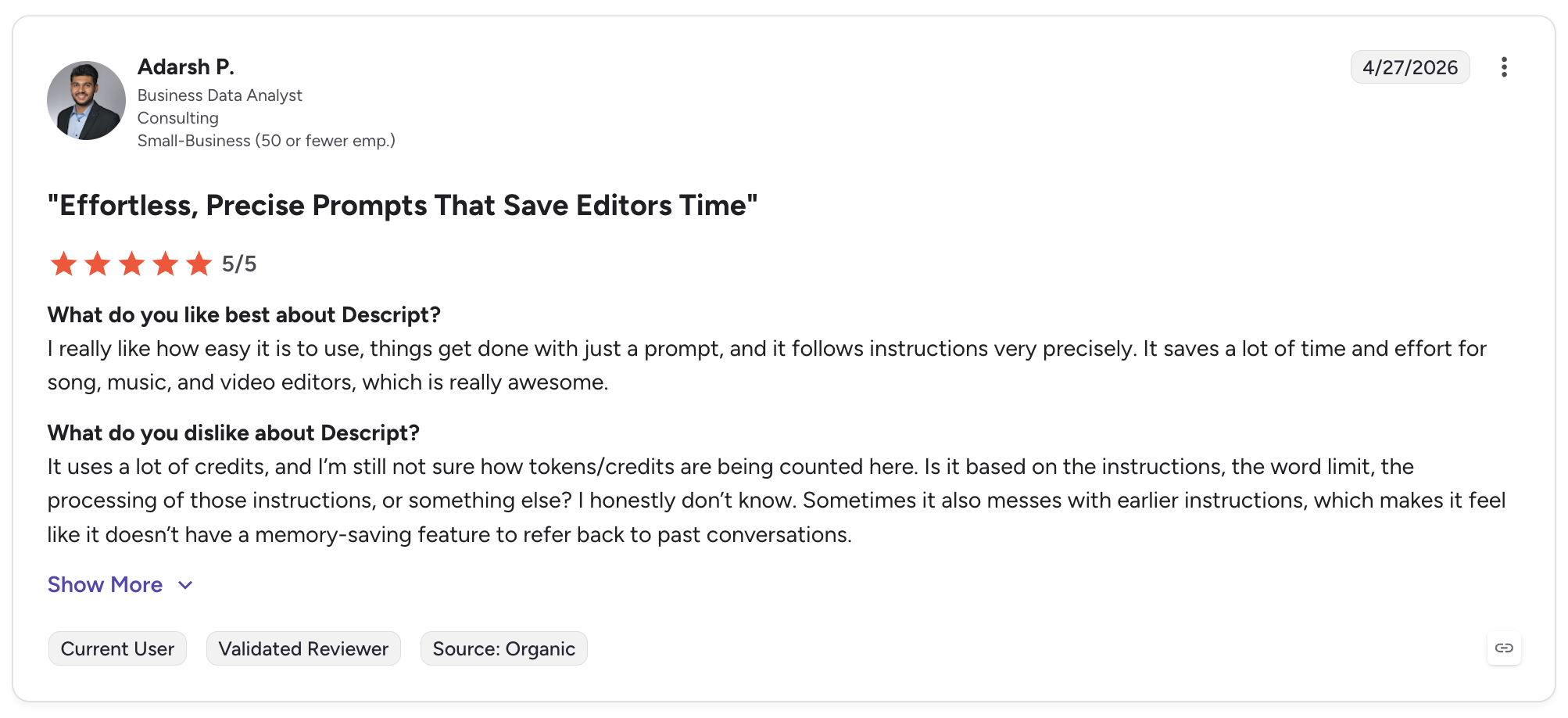
Descript is an all-in-one editing platform that includes Overdub voice cloning. Its differentiator is text-based audio and video editing: you edit the transcript and the media follows. For podcasters, YouTubers, and corporate video teams, this workflow is often more valuable than a standalone voice agent. Descript isn’t a real-time conversational AI tool – it’s a production studio with AI voice features built in.
What Are Descript’s Best Features?
-
Transcript-based editing – cut, rearrange, and refine video or audio by manipulating the transcript like a document.
-
Overdub voice cloning for fixing dialogue from text, plus AI filler word removal, eye contact correction, and Studio Sound audio enhancement.
-
4K watermark-free exports on paid tiers, with multi-track editing and direct publishing to podcast hosts.
-
Pricing from a free plan up through Hobbyist ($16–24/month), Creator ($24–35/month), and Business ($50–65/month) tiers.
-
A genuinely usable free tier with transcription and text-based editing included.
Who is Descript Best for?
Descript is best for podcasters, YouTubers, and corporate video teams whose bottleneck is editing, not voice generation. If you record real humans and want to polish, repurpose, and fix that media fast, Descript’s transcript workflow saves more hours than any voice agent would. It’s the wrong pick if you need real-time conversational AI or large-scale TTS generation – voice features here serve the edit, not the other way around.
What Are G2 Users Rating Descript?
Descript is rated 4.8/5 by 800+ verified users on G2.
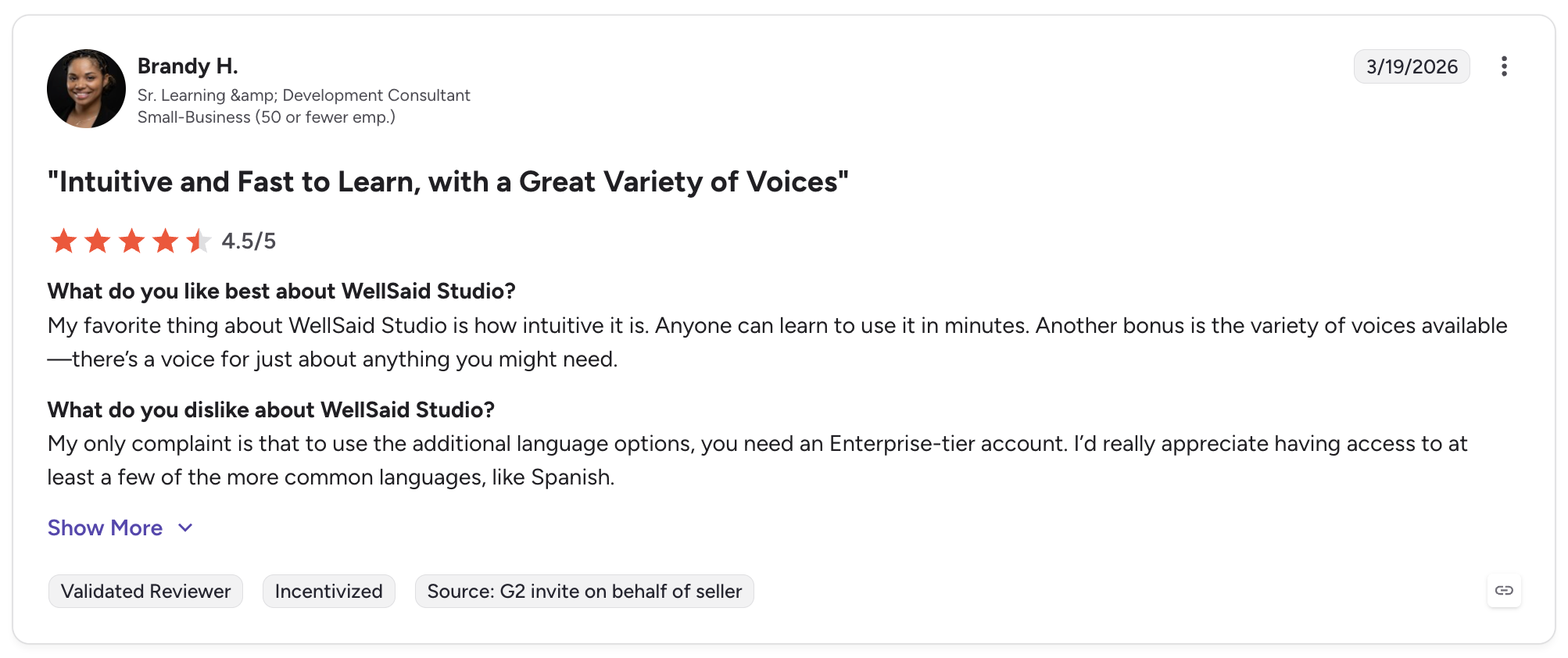
4. WellSaid Labs: Best for enterprise voiceovers
WellSaid Labs focuses on studio-grade voice quality for corporate use cases – training videos, e-learning, internal communications, and brand-consistent voiceover work. The platform emphasizes team collaboration, voice rights management, and ethical sourcing of the voice talent that powers its models. If you need consistent voice output across hundreds of pieces of marketing content, WellSaid is built for that workflow.
What Are WellSaid Labs’ Best Features?
-
Studio-grade AI voices built on ethically sourced, consented voice talent.
-
Custom voice avatars that let organizations create a proprietary AI voice embodying their brand, consistent across all content.
-
Enterprise governance features: usage tracking, access controls, and SOC 2 compliance.
-
Team workspaces and Adobe integrations on the Business tier, with SSO and a dedicated CSM at Enterprise level.
-
Pronunciation libraries for keeping brand and product names consistent across every piece of content.
Who is WellSaid Labs Best for?
WellSaid is best for L&D teams, e-learning producers, and enterprise marketing departments that publish high volumes of branded voiceover and need legal and governance boxes checked. The ethical sourcing and voice rights management matter most to large organizations with compliance requirements. It’s overkill – and overpriced – for solo creators, and it’s not built for conversational AI at all.
What Are G2 Users Rating WellSaid Labs?
WellSaid Labs is rated 4.6/5 by verified users on G2.
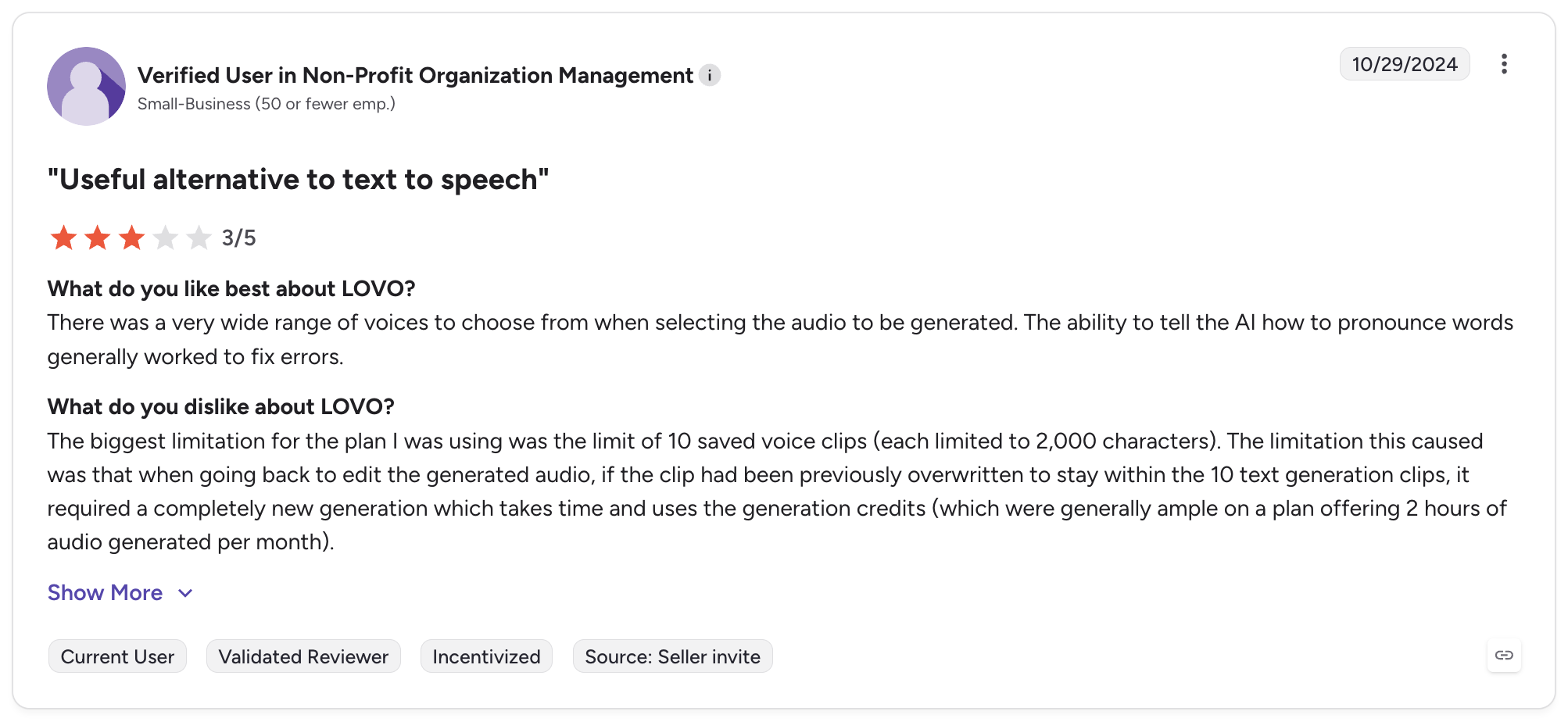
5. LOVO: Best for emotional voiceovers
LOVO offers voices designed for emotional expressiveness – character voices, dramatic narration, and storytelling-driven content. It’s a strong pick for game developers, animators, and creators working on character-driven media. Like Descript and WellSaid, it’s voice-first rather than agent-first; the conversational AI surface is smaller than ElevenLabs’.
What Are LOVO’s Best Features?
-
500+ voices across 100+ languages with 30+ emotions, including character options – ideal for games, animation, and dramatic narration.
-
The Genny all-in-one studio, combining script writing, voice generation, video editing, and subtitle generation in a single interface.
-
Voice cloning from a short sample for consistent brand or character voices across unlimited projects.
-
A pronunciation editor for phonetically fixing how brand names are spoken.
-
Accessible pricing: plans starting around $24/month with commercial rights included, plus a pay-as-you-go API at $0.03 per 1,000 characters.
Who is LOVO Best for?
LOVO is best for game developers, animators, YouTube creators, and storytellers who need expressive, character-driven voices and want production tools bundled in. The Genny studio means you can go from script to finished video without leaving the platform – a real advantage for small teams. It’s not the pick for real-time voice agents or maximum vocal realism, where ElevenLabs still leads.
What Are G2 Users Rating LOVO?
LOVO is rated 4.4/5 by verified users on G2.
For more options across the category, see our roundup of the best AI voice agents.
Final Verdict: Is ElevenLabs Voice Agent Worth It?
ElevenLabs is a strong tool for one thing: voice. But a voice alone doesn’t answer customers, log calls, or book meetings – for that, you’d need to build an entire phone system around it.
CloudTalk is that system already. The AI voice agent, global numbers, CRM sync, and analytics all work together from day one, at a predictable per-user price – no engineering project, no surprise credit bills.
If your goal is better customer conversations, not a development roadmap, CloudTalk is the better choice. Start a free trial and have your first AI agent taking calls this week.
Ready to compare voice AI built for business?