10 Best Voice AI Agents for Reducing Average Handle Time in [cgv actual_year]
Best Voice AI Agents for Reducing Average Handle Time: TL;DR
The best AI voice agents to reduce average handle time pair fast, structured automation with native telephony and CRM handoffs, because the biggest AHT wins come from integration, not conversation length.
CloudTalk leads for teams that want AI voice agents built into a full business phone system, with the rest of the list covering developer infrastructure, no-code builders, and enterprise CCaaS deployments. Here are the top AI voice bots for reducing call duration in [cgv actual_year].
-
01
CloudTalk — Best overall for AHT reduction inside a comprehensive phone system
-
02
Retell AI — Best developer infrastructure for low-latency voice
-
03
Synthflow — Best no-code builder for fast AHT pilots
-
04
Vapi — Best fully custom voice stack for engineering teams
-
05
PolyAI — Best for complex, ambiguous enterprise calls
-
06
NiCE Cognigy — Best for large CCaaS-embedded automation
-
07
Dialpad — Best for real-time agent assist and knowledge surfacing
-
08
Aircall AI — Best for lightweight automation around the agent
-
09
Goodcall — Best entry-level AI receptionist for small business
-
10
Sierra — Best for brand-aligned, outcome-based CX automation
See how CloudTalk’s Voice AI cuts average handle time inside your existing call flows

What Is a Voice AI Agent Designed to Reduce Average Handle Time (AHT)?
An AI voice agent that reduces Average Handle Time (AHT) is a virtual assistant optimized to resolve customer issues quickly, rather than to hold long, human-sounding conversations. Unlike rigid phone menus, these agents use fast intent recognition to let callers speak naturally, instantly verifying identities and pulling account data to resolve the request or hand it off to a human with a complete summary attached.
Key features include:
- Clean Handoffs: Passes the caller and their context to a human agent seamlessly, avoiding repetitive questioning.
- Structured Dialogue: Drives the conversation forward efficiently to prevent rambling.
- Instant Automation: Handles verification and data lookup in seconds, eliminating “dead air.”
The goal is to shorten call duration while protecting resolution quality. These agents handle high-volume, repeatable tasks:
- password resets,
- order status,
- appointment changes,
- balance inquiries,
- and escalate the genuinely complex calls to humans with better context, which lowers overall handle time without hurting customer satisfaction.
The biggest gains come from the parts of the call customers never think about:
- call routing that lands the caller in the right place the first time,
- and after-call work that gets automated instead of typed.
For a deeper breakdown of the metric itself, see CloudTalk’s guide to average handle time, and the role it plays in call center automation.
How We Evaluated the Best AI Voice Agents for Reducing AHT
We focused on the factors that move AHT in live call environments rather than demo conditions: native telephony integration, latency and interruption handling, efficient information capture, structured handoffs into CRM and agent workflows, deployment effort, and verified G2 ratings.
We prioritized platforms that demonstrably lower time-to-resolution, and we noted where a tool’s strengths sit, infrastructure, no-code speed, or enterprise managed delivery, so you can match it to your stack. For more on the metrics behind this, CloudTalk’s guides on call tracking metrics and call center benchmarking are useful companions.
Why Trust Our Software Reviews?
Every platform below was assessed against published pricing, current G2 ratings, and documented customer outcomes, not marketing claims. CloudTalk’s own numbers are tied to live data, and competitor figures are drawn from each vendor’s published rates and verified review platforms. Y
ou can read how we keep this honest in our content integrity statement and software review methodology. The industry context throughout, including the roughly six-minute AHT benchmark and the 35% to 50% reduction range AI-integrated teams report, is drawn from primary contact center research.
10 Best Voice AI Agents for Reducing Average Handle Time: Comparison Table
| Software Name | Best For | Deployment & Ease of Use | Integrations & Handoff | Pricing | G2 Rating |
|---|---|---|---|---|---|
| CloudTalk | AHT reduction inside a full phone system | No-code, fast rollout | Native telephony + CRM, clean handoff | From $[cgv pricing_lite]/user/mo | [cgv rating_g2] |
| Retell AI | Low-latency developer infrastructure | Low-code + SDK | BYO telephony, broad integrations | From $0.07/min | 4.8/5 |
| Synthflow | Fast no-code AHT pilots | No-code, drag-and-drop | Twilio + CRM, varies by tier | ~$0.13–0.24/min all-in | 4.5/5 |
| Vapi | Fully custom voice stack | Developer-only | BYO stack, total control | $0.05/min base ($0.18–0.33 real) | 4.5/5 |
| PolyAI | Complex, ambiguous enterprise calls | Managed service | Deep CCaaS + CRM, vendor-led | Custom (six-figure annual) | 5.0/5 |
| NiCE Cognigy | Large CCaaS-embedded automation | Low-code, enterprise build | Native CCaaS (Genesys, Avaya, CXone) | Custom (enterprise) | 4.6/5 |
| Dialpad | Real-time agent assist | Moderate, UCaaS setup | Native CRM, knowledge surfacing | From $15/user/mo (Connect) | 4.3/5 |
| Aircall AI | Lightweight automation around the agent | Easy, fast onboarding | 250+ integrations, AI as add-on | From $30/license/mo + AI add-ons | 4.4/5 |
| Goodcall | Entry-level AI receptionist | No-code, live in minutes | Zapier-based, limited native CRM | From $59–79/mo per agent | 4.4/5 |
| Sierra | Brand-aligned, outcome-based CX | Enterprise build | Action-oriented CRM integrations | Custom (outcome-based) | N/A |
10 Best AI Voice Agents for Reducing Average Handle Time in [cgv actual_year] [Expert Picks]
Below is a detailed look at each of the top ai voice platforms for faster customer interactions, what it does, where it shines, and where it falls short for AHT reduction specifically.
1. CloudTalk — Best Voice AI for Reducing AHT Inside a Real Phone System

AI Voice Agents

Nudge expiring offer
Riley, Sales Reminder Agent

Qualify a student lead
Avery, Course Inquiry Agent

Get a payment reminder
Casey, Payment Reminder Agent

Qualify a patient lead
Jordan, Healthcare Intake Agent

Qualify insurance lead
Taylor, Insurance Intake Agent

Accept updated terms
Quinn, T&C Acceptance Agent

Qualify legal inquiry
Drew, Legal Intake Agent

Get post-interview feedback
Jamie, Candidate Feedback Agent

Pre-screen a candidate
Skyler, Applicant Pre-screen Agent

Confirm account action
Morgan, Action Reminder Agent

Get a renewal reminder
Logan, Subscription Renewal Agent

Get CSAT after support
Morgan, CX Feedback Agent

Get NPS or demo feedback
Parker, Post-Sales Feedback Agent

Qualify a trial lead
Blake, Trial Signup Qualifier
Sales Reminder
Agent
Client
Sales / Marketing
Course Inquiry
Agent
Client
Education / EdTech
Payment Reminder
Agent
Client
Financial Services
Healthcare Intake
Agent
Client
Healthcare
Insurance Intake
Agent
Client
Insurance
T&C Acceptance
Agent
Client
Legal Services
Legal Intake
Agent
Client
Legal Services
Candidate Feedback
Agent
Client
Recruitment / HR
Applicant Pre-screen
Agent
Client
Recruitment / HR
Action Reminder
Agent
Client
SaaS / Software & Apps
Subscription Renewal
Agent
Client
SaaS / Software & Apps
CX Feedback
Agent
Client
SaaS / Software & Apps
Post-Sales Feedback
Agent
Client
SaaS / Software & Apps
Trial Signup
Qualifier
Client
SaaS / Software & Apps
What Is CloudTalk?
CloudTalk is an AI-powered business phone system built for sales and support teams, used by [cgv customers_around_the_world]+ companies worldwide with [cgv national_phone_numbers]+ national phone numbers.
For AHT, the difference is structural: CloudTalk’s AI voice agents live inside the telephony layer, not bolted on through a third-party connector. That means intake, routing, and data capture happen natively, and the call lands in front of a human, when it needs to, with the context already gathered. The biggest AHT lever is rarely the conversation itself; it is the friction around it, and that is exactly what CloudTalk automates.
Key Features of CloudTalk for Reducing AHT
-
AI Voice Agents — automate the first 60 seconds of every call: intake, authentication, and qualification before a human is involved
-
Intelligent call routing — skill-based routing lands callers in the right place the first time, cutting transfers
-
AI Smart Notes & summaries — automated after-call work removes manual wrap-up time
-
Conversation intelligence — sentiment analysis and call scoring to spot AHT bottlenecks
-
Native CRM integrations — deep two-way sync with HubSpot, Salesforce, Zendesk, and more, so context surfaces instantly
-
Workflow automation — trigger-based actions that handle repetitive post-call tasks automatically
What Is CloudTalk’s Pricing?
CloudTalk offers transparent, all-inclusive per-user pricing with a [cgv days_free]-day free trial and no credit card required, so there is no per-minute math or hidden provider stacking. AI voice agent capabilities are available from the Expert tier upward. For a full cost breakdown, see the call center software cost guide.
- Lite: $[cgv pricing_lite]/user/month (NA & LATAM only)
- Starter: $[cgv pricing_starter]/user/month
- Essential: $[cgv pricing_essential]/user/month
- Expert: $[cgv pricing_expert]/user/month (includes AI voice agents)
CloudTalk G2 Reviews and User Feedback
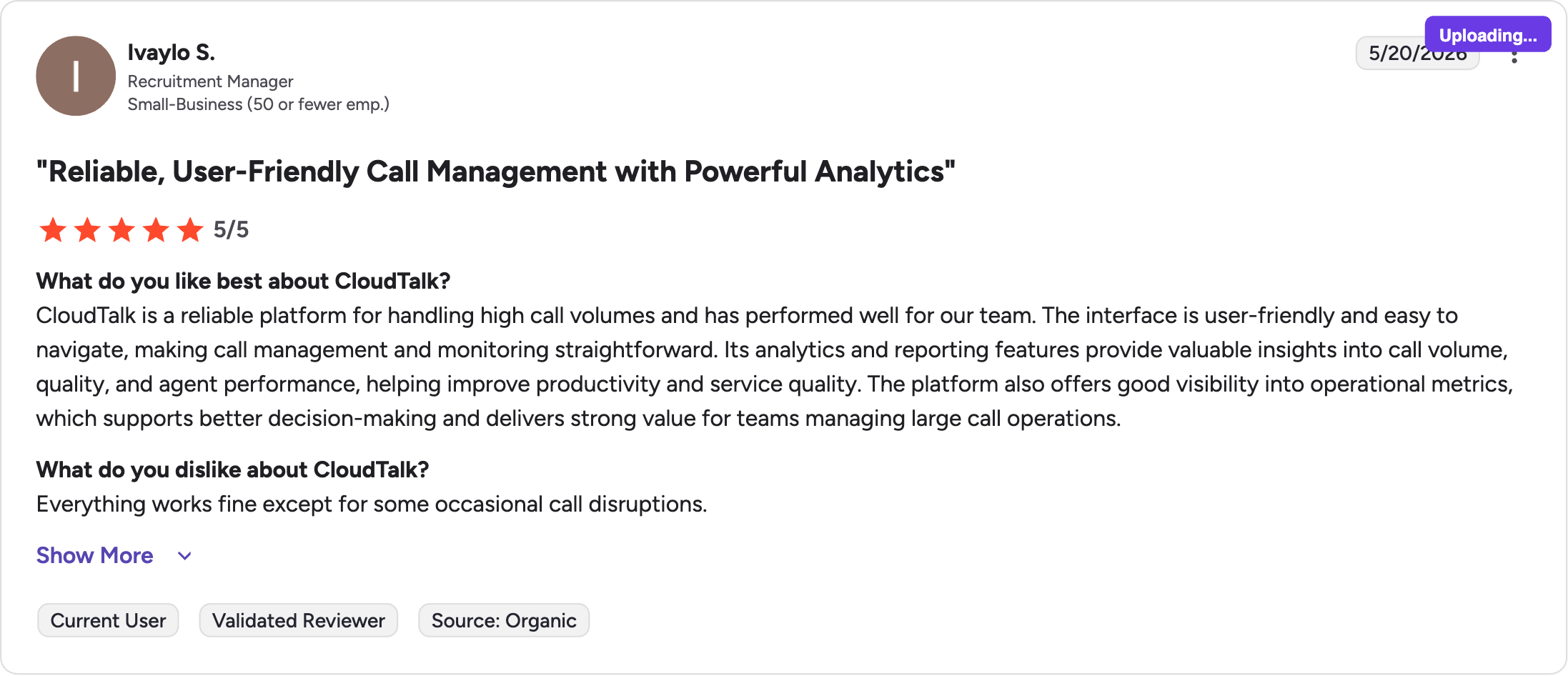
G2 reviewers give CloudTalk [cgv rating_g2] across [cgv reviews_on_g2]+ reviews. Users consistently highlight the call quality, the depth of CRM integrations, and how quickly teams get the AI features live without an engineering project.
CloudTalk is Best for:
For teams whose goal is measurable AHT reduction rather than a standalone voice bot, CloudTalk is the cleanest fit.
It removes the integration work that usually erases AHT gains, automating the front of the call and the after-call work in one platform, while keeping humans in the loop for the calls that need judgment.
It is easy to setup, even your own human agents can do it! So engineering teams wanting to assemble every component themselves will look at Retell or Vapi.
But for everyone who wants the phone answered faster and the wrap-up done automatically, it delivers AHT wins without operational overhead.
| Pros | Cons |
|---|---|
| Native telephony + AI — automation lives inside the phone system, not a connector | Full AI on higher tiers — the complete voice agent set sits on Expert |
| Automated after-call work — AI summaries and notes cut wrap-up time | Not a dev toolkit — less low-level control than Vapi or Retell |
| Transparent per-user pricing — no per-minute stacking or surprise provider fees | Lite is region-limited — entry tier is NA & LATAM only |
Automate the first 60 seconds of every call
2. Retell AI — Best Voice AI Infrastructure for Low-Latency Call Handling
What Is Retell AI?
Retell AI is a purpose-built voice agent infrastructure platform that powers tens of millions of calls a month for thousands of businesses. It is AI-native rather than a retrofitted chatbot, with low-latency streaming and barge-in handling that keep conversations fast and natural, both of which matter for AHT because above the 500ms latency threshold, callers start talking over the agent and add seconds to every call. It pairs a low-code visual builder with a full developer SDK, so technical teams get control without rebuilding the entire voice pipeline.
Key Features of Retell AI
-
Low-latency streaming — sub-second response times that avoid interruption loops
-
Barge-in handling — the agent stops and listens when a caller interrupts
-
Bring-your-own stack — choice of LLM, voice, and telephony providers
-
Built-in QA and testing — simulate calls, A/B test flows, monitor live data
What Is Retell AI’s Pricing?
Retell uses pay-as-you-go pricing starting at $0.07 per minute for voice agents with no platform fee, plus $10 in free credits and 20 free concurrent calls. The headline rate covers the orchestration layer; once LLM and telephony are added, real production cost typically lands between $0.13 and $0.31 per minute. An Enterprise tier starts around $8,000 and adds managed setup and a dedicated support channel. For predictable per-seat pricing instead, compare the cost of call center software.
- Pay-as-you-go: from $0.07/min (orchestration only)
- Enterprise: from $8,000 with managed onboarding
Retell AI G2 Reviews
G2 reviewers give Retell AI 4.8/5. Reviewers praise the low latency and natural call quality, while the most common drawback is that modular per-component costs can be hard to forecast at scale.
| Pros | Cons |
|---|---|
| Excellent latency — fast streaming avoids interruption-driven AHT inflation | Unpredictable cost — stacked component pricing rises at scale |
| Developer flexibility — full control over the voice stack | Needs technical resources — not a turnkey business phone system |
3. Synthflow — Best No-Code Builder for Fast AHT Pilots
What Is Synthflow?
Synthflow is a no-code voice AI platform whose drag-and-drop flow designer is the most consistently praised in its category. Its appeal for AHT work is speed to a first call: pick a template for intake, verification, or FAQ handling, write a prompt, plug in a number, and you can have a working agent live in under an hour. That makes it a practical choice for teams that want to pilot AHT-reduction flows without developers, with pre-built templates covering common front-of-call tasks.
Key Features of Synthflow
-
No-code visual builder — branching flows, variable capture, and webhooks without code
-
Template library — pre-built intake, verification, and booking flows
-
Live call monitoring — monitor, whisper, barge-in, and take-over controls
-
Integrations — HubSpot, Salesforce, GoHighLevel, Zapier, and Twilio
What Is Synthflow’s Pricing?
Synthflow moved to a pay-as-you-go model for new signups, with all-in cost typically running $0.13 to $0.24 per minute once bring-your-own-key provider costs are included. Legacy subscription tiers ranged from a $29/month Starter up to roughly $1,400/month for higher-volume plans. A key caveat: real costs can run 2 to 3 times the advertised rate once BYOK provider fees are added. For predictable budgeting, weigh it against the cost of call center software.
- Pay-as-you-go: ~$0.13–0.24/min all-in
- Legacy tiers: from $29/month up to ~$1,400/month
Synthflow G2 Reviews
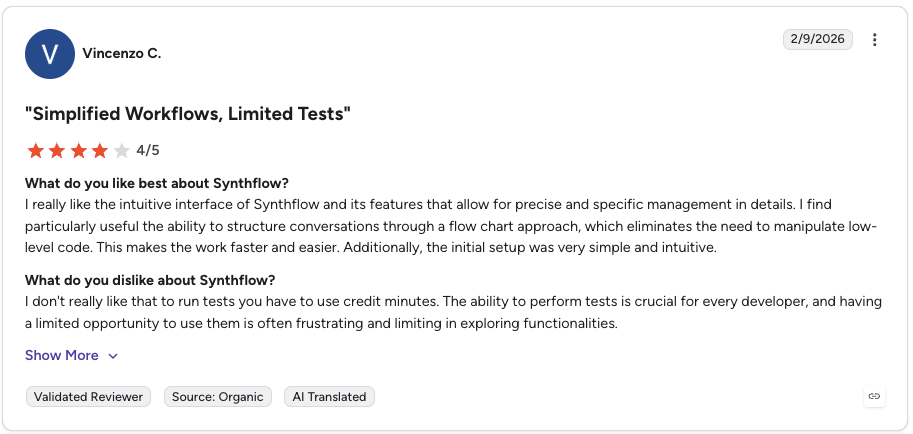
G2 reviewers give Synthflow 4.5/5. Ease of setup is the standout strength, while the recurring complaints are platform stability on lower tiers and useful builder features being gated behind higher plans.
| Pros | Cons |
|---|---|
| Fastest to first call — live AHT pilots in under an hour | Feature gating — useful builder tools locked to higher tiers |
| Strong no-code builder — branching flows without code | BYOK cost surprises — real spend can run 2–3x advertised |
4. Vapi — Best Fully Custom Voice Stack for Engineering Teams
What Is Vapi?
Vapi is voice AI infrastructure, an orchestration layer that connects speech-to-text, LLM, text-to-speech, and telephony into a working call flow through APIs. It is not a finished product; it is a toolkit. For AHT, that is a double-edged sword: Vapi gives total control over dialog length, verification logic, escalation timing, and even silence thresholds, so a skilled team can aggressively optimize for speed. But there are no guardrails, every second saved or wasted is a direct consequence of how well the system is engineered, and gains can be fragile when callers hesitate or interrupt.
Key Features of Vapi
-
Assistants API — configure prompts, voices, and conversation timing
-
Squads — chain specialized agents with mid-call handoffs
-
Function calling — trigger CRM updates and external APIs mid-call
-
Knowledge base (RAG) — answer from your own docs during live calls
What Is Vapi’s Pricing?
Vapi charges a $0.05 per-minute platform fee, but that covers orchestration only. Once you add STT, LLM, TTS, and telephony, real-world cost typically lands between $0.18 and $0.33 per minute, and new accounts get 60 free minutes. Pay-as-you-go includes 10 concurrent call slots, with extra concurrency and a custom Enterprise plan available. To see this in detail, CloudTalk’s Vapi AI pricing breakdown maps the full stack.
- Pay-as-you-go: $0.05/min platform fee ($0.18–0.33 all-in)
- Enterprise: custom, with volume pricing and SLAs
Vapi G2 Reviews
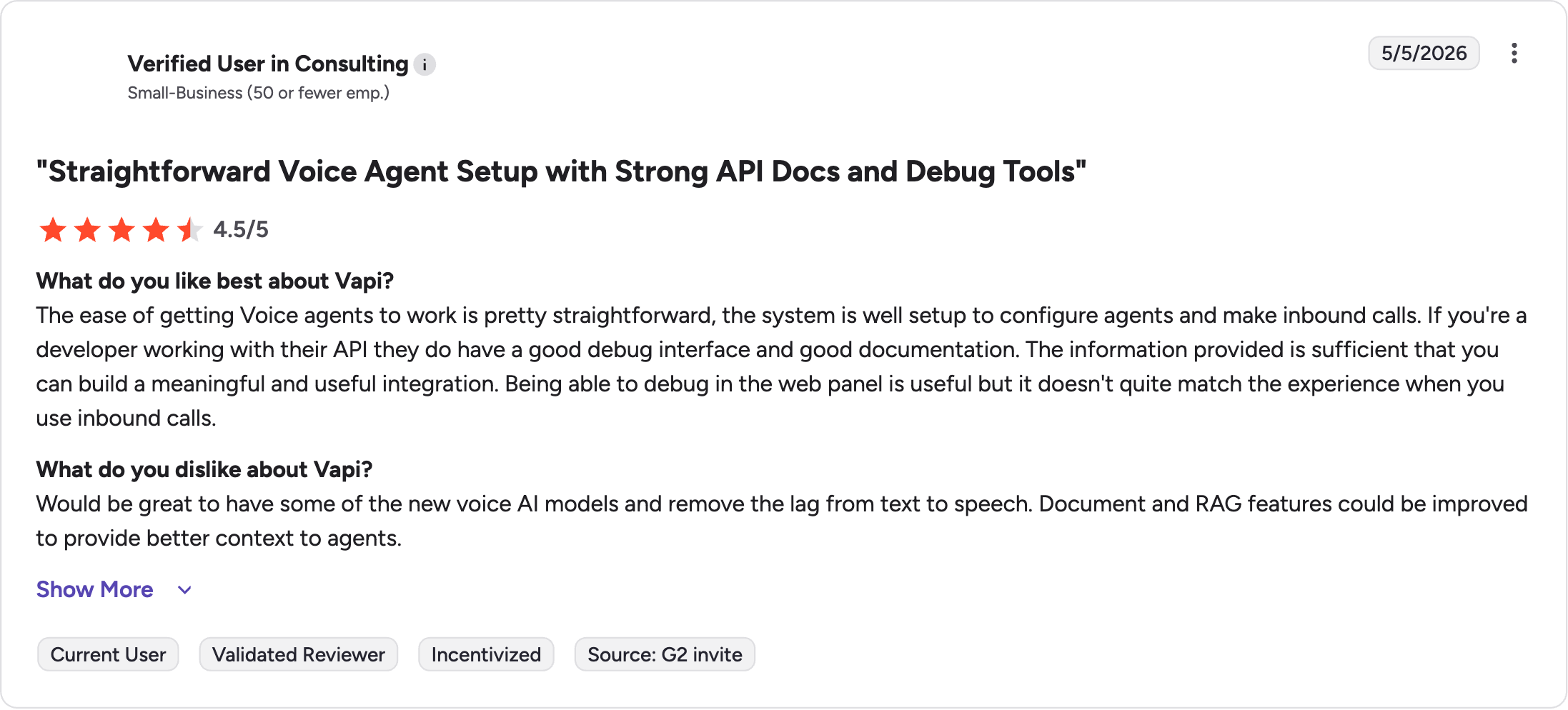
G2 reviewers give Vapi 4.5/5. Developers praise the flexibility and low base cost, while the most cited drawback is unpredictable latency, which can directly inflate AHT, and complex multi-provider billing.
| Pros | Cons |
|---|---|
| Total control — tune dialog length and escalation for speed | No guardrails — AHT gains are fragile without careful engineering |
| Flexible stack — choose every provider | Latency variance — multi-provider chaining can add dead air |
Want AHT reduction without engineering a voice stack from scratch?
5. PolyAI — Best for Complex, Ambiguous Enterprise Calls
What Is PolyAI?
PolyAI is an enterprise conversational AI provider that builds bespoke voice assistants for large brands in banking, healthcare, hospitality, and utilities. Its differentiator is handling messy, multi-turn calls, heavy accents, unclear requests, and background noise, because its speech recognition is trained on millions of real customer calls. For AHT, that ambiguity handling matters: when a caller says “I need to change my thing,” PolyAI asks natural clarifying questions instead of forcing a rigid menu, which prevents the misrouting and repetition that pad handle time. In published deployments it has handled 80%+ of certain transactional calls without escalation. See CloudTalk’s deeper look at PolyAI pricing for the enterprise math.
Key Features of PolyAI
-
Ambiguity handling — manages non-linear, multi-turn conversations naturally
-
Accent and noise robustness — trained on millions of real calls
-
Managed deployment — PolyAI designs, builds, and tunes the agent for you
-
Deep CCaaS integration — connects to Genesys, Salesforce Service Cloud, and more
What Is PolyAI’s Pricing?
PolyAI does not publish public pricing. It uses custom enterprise quotes with usage-based per-minute billing, and market reports suggest contracts often start around six figures annually plus usage. There is no self-serve tier or free trial; you engage sales for a scoped deployment. For more accessible per-user options, compare against the call center software cost guide.
- Enterprise (custom): usage-based per-minute, ~six-figure annual contracts
PolyAI G2 Reviews
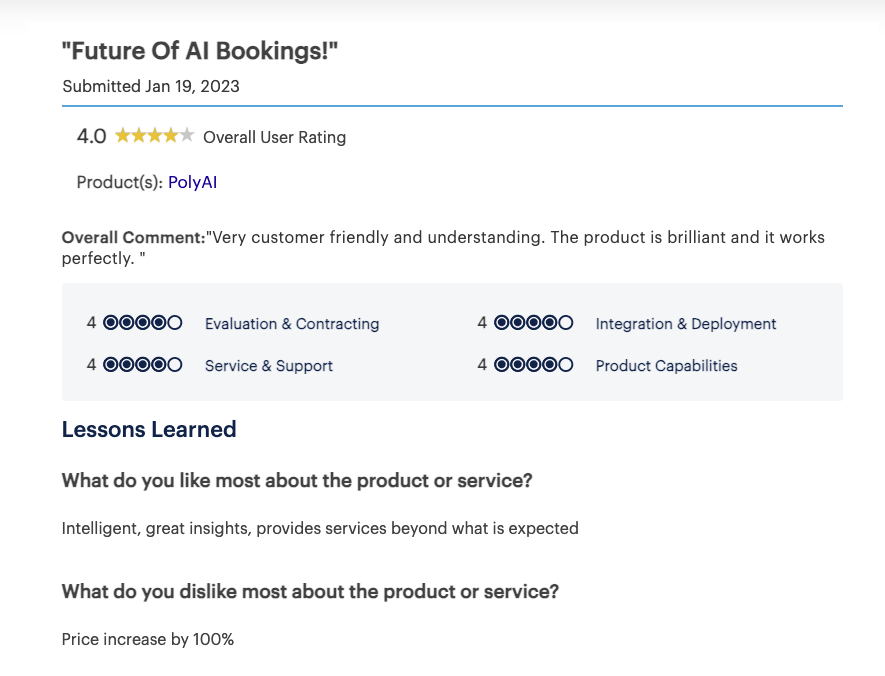
Gartner Peer Insights reviewers give PolyAI 4.7/5. Voice quality and natural understanding are the standout praise; the consistent critiques are premium cost and limited self-service iteration speed.
| Pros | Cons |
|---|---|
| Handles ambiguity — reduces misroutes and repetition on complex calls | Premium cost — six-figure contracts favor high call volumes |
| Industry-leading voice — natural, branded speech | Slow iteration — most changes go through account teams |
6. NiCE Cognigy — Best for Large CCaaS-Embedded Automation
What Is NiCE Cognigy?
Cognigy, now NiCE Cognigy following its 2025 acquisition, is an enterprise low-code conversational AI platform used by over 1,000 brands including Bosch, DHL, Lufthansa, and Mercedes-Benz. It is technology-agnostic, integrating natively with CCaaS platforms like Amazon Connect, Genesys Cloud, NiCE CXone, and Avaya, and lets teams mix and match LLM, NLU, STT, and TTS. For AHT specifically, Cognigy markets high containment plus lower handle time during escalations, the AI gathers and verifies information, then passes a structured summary to the agent so the human portion is shorter.
Key Features of NiCE Cognigy
-
Agentic AI agents — voice and digital agents that take action in backend systems
-
Agent Copilot — real-time assist that cuts handle time on escalated calls
-
Native CCaaS integration — pre-built connectors for Genesys, Avaya, CXone, Amazon Connect
-
Low-code flow builder — business users design dialog flows without heavy coding
What Is NiCE Cognigy’s Pricing?
Cognigy does not publish fixed tiers; pricing is sales-led and scoped to usage, channels, integrations, and support level. Based on public reviews and market norms, smaller pilots often start around $2,500 to $5,000 per month, while larger deployments land in the $100,000 to $350,000+ per year range once licenses, usage, and services are included. Voice minutes and LLM tokens are typically billed separately. For predictable per-seat alternatives, see the call center software cost guide.
- Pilot / entry: ~$2,500–5,000/month (sales-led)
- Enterprise: ~$100,000–350,000+/year, scope-dependent
NiCE Cognigy G2 Reviews
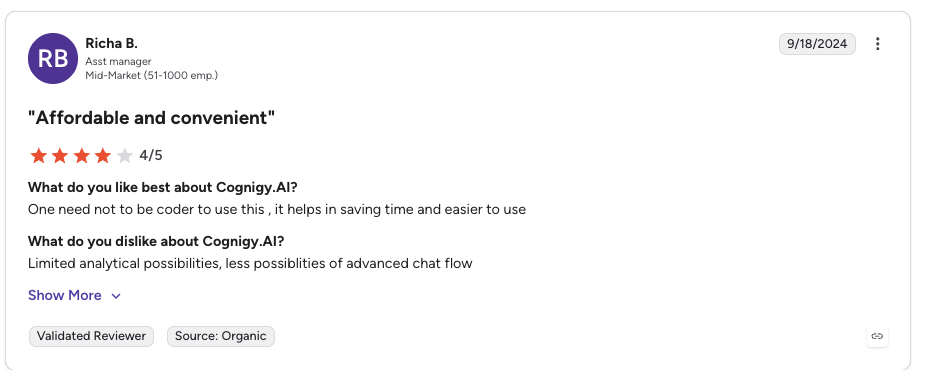
G2 reviewers give NiCE Cognigy 4.6/5. Reviewers credit it for driving contact center KPIs including AHT and deflection, while noting that advanced configuration requires real skills and that Voice Gateway could be more tightly integrated.
| Pros | Cons |
|---|---|
| Deep CCaaS fit — native connectors lower AHT inside existing stacks | Enterprise complexity — long build cycles before full automation |
| Agentic + copilot — automation plus real-time agent assist | Opaque pricing — custom quotes are hard to forecast |
7. Dialpad — Best for Real-Time Agent Assist and Knowledge Surfacing
What Is Dialpad?
Dialpad is an AI-powered business communications platform whose strongest AHT lever is real-time assist. The single biggest source of handle time is the hold button, McKinsey found 30% to 40% of complex call time is silent while agents look things up, and Dialpad’s live transcription and knowledge surfacing aim to eliminate exactly that. AI summaries, sentiment analysis, and automated notes also cut after-call work. It is sold as separate products (Connect, Support, Sell, and credit-based AI Agents), so contact center buyers should map which one they actually need. Compare it in CloudTalk’s Dialpad pricing guide.
Key Features of Dialpad
-
Real-time transcription — surfaces answers so agents stop searching mid-call
-
AI summaries and notes — automated after-call work
-
Live coaching — real-time guidance to keep escalated calls efficient
-
AI Agents — autonomous voice and text agents (credit-based add-on)
What Is Dialpad’s Pricing?
Dialpad Connect (business phone) starts at $15/user/month annually for Standard, $25 for Pro. Dialpad Support (contact center) starts at $80/user/month. Dialpad AI Agents use a separate credit-based model with no published per-conversation rate, which makes AHT-automation budgeting harder. Core AI features like transcription are included across plans, but advanced AI tools sit on Pro or higher. See the full Dialpad pricing breakdown.
- Connect Standard: $15/user/month
- Connect Pro: $25/user/month
- Support (contact center): from $80/user/month
- AI Agents: credit-based, contact sales
Dialpad G2 Reviews
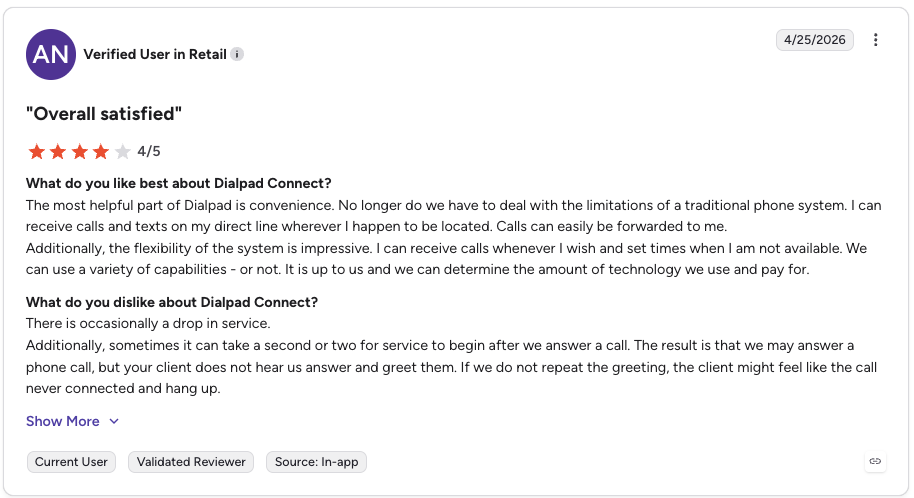
G2 reviewers give Dialpad 4.3/5. The AI transcription and summaries earn consistent praise; recurring complaints cluster around transcription lag, call quality issues, and AI features gated to higher tiers.
| Pros | Cons |
|---|---|
| Real-time assist — knowledge surfacing kills hold-time AHT | Multi-product split — phone and contact center sold separately |
| AI included on base — transcription and summaries across plans | Opaque AI Agent pricing — credit-based, hard to forecast |
8. Aircall AI — Best for Lightweight Automation Around the Agent
What Is Aircall AI?
Aircall is a cloud phone system used by 22,000+ businesses, known for fast setup and best-in-class CRM integrations. Its AI does not try to resolve complex issues autonomously; instead it shortens calls by improving what happens around the agent, faster routing, AI call summaries, and reduced after-call work. In practice that produces small but consistent AHT gains: calls reach the right agent faster, and agents spend less time on basic questions or documentation. The AI Voice Agent and AI Assist features are paid add-ons layered on the core phone system.
Key Features of Aircall AI
-
AI Voice Agent — handles inbound (and outbound) routine calls, English/Spanish/French/German
-
AI Assist — post-call summaries and topic detection that cut wrap-up time
-
250+ integrations — deep HubSpot and Salesforce sync for instant context
-
Power Dialer and Smartflows — outbound efficiency and routing logic
What Is Aircall’s Pricing?
Aircall uses a per-license model with a 3-license minimum: Essentials at $30/license/month and Professional at $50/license/month (annual), with a quote-based Custom tier requiring 25 licenses. AI features add cost on top, AI Assist starts at $9/license, AI Assist Pro is $49/license, and the AI Voice Agent carries its own per-minute rate. See the full Aircall pricing breakdown, since add-ons can push real cost well above sticker.
- Essentials: $30/license/month (3-license minimum)
- Professional: $50/license/month
- AI add-ons: AI Assist from $9/license; AI Voice Agent per-minute
Aircall G2 Reviews
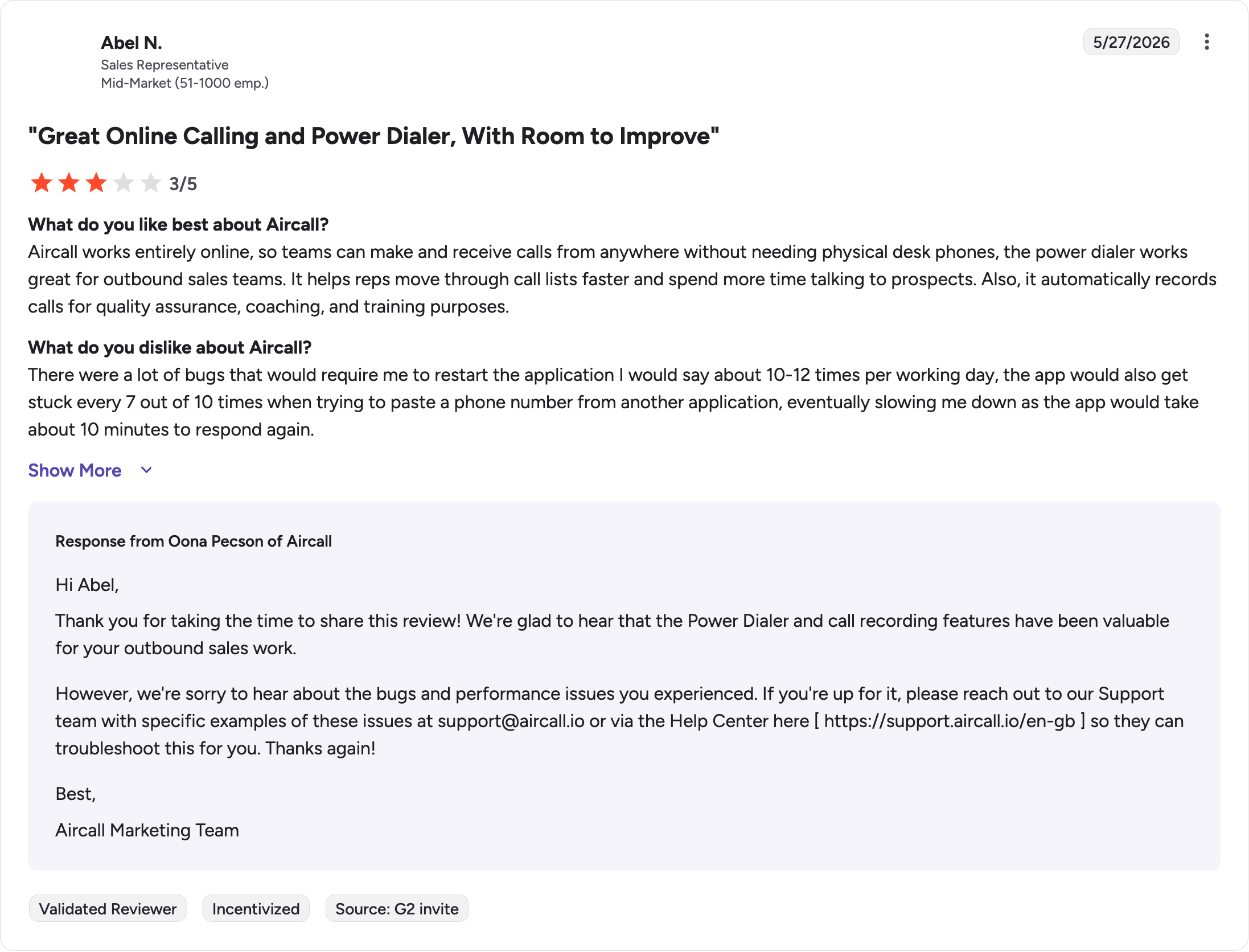
G2 reviewers give Aircall 4.4/5. Ease of use and CRM integrations are the top strengths; the recurring negatives are connection issues, AI features priced as add-ons, and a per-license model that penalizes small teams.
| Pros | Cons |
|---|---|
| Fast onboarding — live in a day or two with strong CRM sync | AI as add-on — AHT automation costs extra on top of seats |
| 250+ integrations — instant context surfacing | Lightweight AI — assists rather than autonomously resolves |
9. Goodcall — Best Entry-Level AI Receptionist for Small Business
What Is Goodcall?
Goodcall is an AI phone assistant that answers calls, captures leads, and handles basic questions for small businesses, with over 10,000 users and a Google-ecosystem heritage. For AHT, its value is at the simplest end of the spectrum: it instantly answers high-volume, repeatable calls, hours, location, basic service questions, so those never reach a human at all. Setup takes minutes with no-code “skills” and flows, and 20+ industry templates cover trades, clinics, and salons. It is a Level 1 solution, strong on structured intents but limited when calls go off-script.
Key Features of Goodcall
-
No-code skills and flows — conditional logic and FAQ handling without code
-
Unlimited minutes — no per-minute meter on any plan
-
Lead capture — pushes contact details to Google Sheets, SMS, or email
-
Industry templates — 20+ verticals for fast setup
What Is Goodcall’s Pricing?
Goodcall charges per agent with unlimited minutes, but bills on unique callers rather than call duration. Plans run roughly $59 to $79/month (Starter) up to $199 to $249/month (Scale), each capping unique callers, with a $0.50 charge per caller over the cap. A 14-day free trial is available. The unique-caller model rewards long calls but can get expensive for high-volume, short-call businesses; compare predictable per-seat options in the call center software cost guide.
- Starter: from ~$59–79/month per agent
- Growth: ~$99–129/month
- Scale: ~$199–249/month
Goodcall G2 Reviews
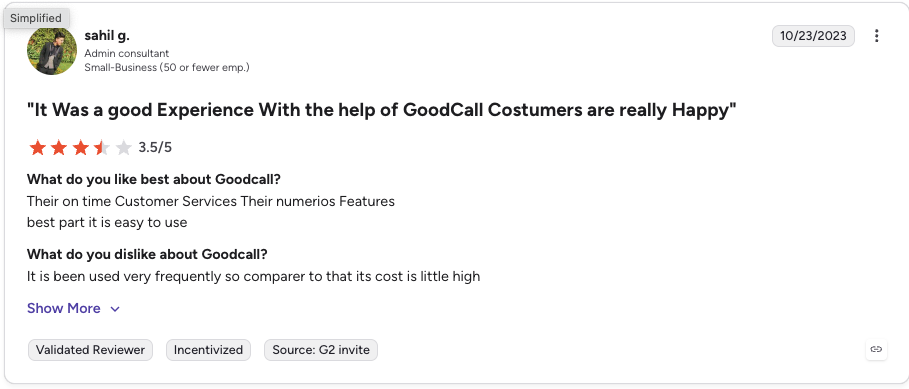
G2 reviewers give Goodcall 4.4/5. Reviewers like the fast setup and unlimited minutes for long calls; the common drawbacks are a slightly robotic voice, Zapier-only integrations, and overage costs that climb as caller volume grows.
| Pros | Cons |
|---|---|
| Live in minutes — instantly deflects simple high-volume calls | Low ceiling — struggles once calls go off-script |
| Unlimited minutes — long calls aren’t penalized | Unique-caller billing — overages add up for high-volume callers |
10. Sierra — Best for Brand-Aligned, Outcome-Based CX Automation
What Is Sierra?
Sierra is an enterprise CX platform whose action-oriented agents integrate with CRMs, subscription tools, and order platforms to actually complete tasks, processing returns, updating records, troubleshooting, during the call. Brands like WeightWatchers, OluKai, and Sonos use it for high-volume support and technical troubleshooting. For AHT, the relevant strength is autonomous resolution plus a multi-model architecture that reduces hallucination risk, so routine, high-frequency calls get resolved end-to-end without a transfer. The trade-off is positioning: Sierra optimizes for brand-consistent experience and successful outcomes, which suits enterprises where the phone experience is the brand.
Key Features of Sierra
-
Action-oriented agents — execute tasks in backend systems during the call
-
Multi-model architecture — multiple LLMs for reliability and fewer hallucinations
-
Omnichannel — consistent agents across voice and other channels
-
Brand guardrails — strong policy enforcement and governance controls
What Is Sierra’s Pricing?
Sierra uses outcome-based pricing tied to successful resolutions rather than per-minute or per-conversation rates, with no public pricing and an enterprise contract required to start. That model can align cost with value, but it requires a sales engagement and is geared to large brands. For transparent, published per-seat pricing instead, see the call center software cost guide.
- Enterprise (custom): outcome-based, priced per successful resolution
Sierra G2 Reviews
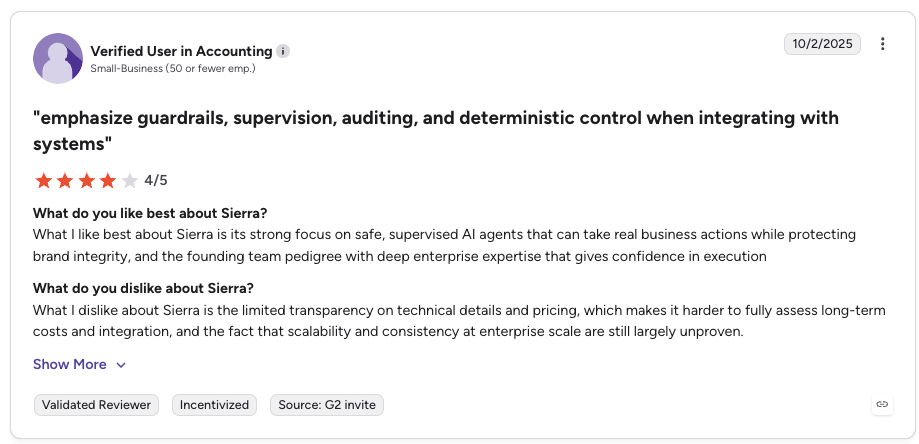
Sierra has a limited verified review footprint on G2 as of [cgv actual_year], so treat sentiment as directional. Enterprise buyer commentary and industry coverage consistently highlight conversational quality and brand consistency, while flagging the six-figure commitment and the enterprise-only motion as barriers for smaller teams.
| Pros | Cons |
|---|---|
| Autonomous resolution — completes tasks end-to-end, avoiding transfers | Enterprise-only — contract and scale requirements exclude SMBs |
| Outcome-based pricing — cost tied to successful resolutions | Thin public reviews — limited verified sentiment to date |
Compare the shortlist against the one built into your phone system
How to Choose a Conversational AI Platform for Your Tech Stack (Based on Real AHT Testing)
Choosing the best ai voice assistants for faster call resolution should center on how the platform performs inside your real tech stack, not how it sounds in a demo. The best voice ai tools for faster customer call handling reduce AHT through smooth integration into business phone systems and call flows, not conversation quality alone. Here are the criteria that actually predict AHT outcomes.
Native Telephony Integration
The single biggest predictor of AHT results is whether the agent lives inside your phone system or talks to it through a connector. Native telephony means intake, authentication, and routing happen in one layer with no handoff lag. Weak telephony integration limits AHT reduction even when the AI performs well, so confirm how the platform handles caller ID, number management, and call routing before anything else.
Latency and Interruption Handling
Above roughly 500ms of latency, callers begin talking over the agent, creating interruption loops that add 15 to 20 seconds per call, turning a latency problem into an AHT problem. Test real calls and listen for overlap handling, barge-in recovery, and dead air introduced by multi-provider chaining.
Efficient Information Capture and Verification
Authentication and intake are where minutes hide. Voice biometrics and contextual data can cut authentication steps by up to 70%, so look for an agent that verifies identity and gathers context fast, ideally before a human is ever involved. This is the front-of-call lever that produces the most consistent AHT gains.
Structured Handoffs and CRM Compatibility
When a call does escalate, the human portion should be short because the AI already gathered and verified everything. That requires a structured handoff with a summary attached and deep CRM integration so context surfaces instantly. The best platforms also automate after-call work, which removes wrap-up time from AHT entirely.
Deployment Effort and Iteration Speed
Enterprise CCaaS deployments can take three to six months to compound AHT gains, while no-code tools go live the same day. Match deployment effort to your team: developer infrastructure suits engineering teams, no-code builders suit fast pilots, and native phone systems suit teams that want results without a build project. Track containment rate, transfer rate, and cost per resolved interaction alongside AHT so you optimize the whole picture, not one number. CloudTalk’s call center optimization guide covers how to run that measurement loop.
Pricing Transparency and Predictability
Per-minute models look cheap until you stack LLM, voice, and telephony costs; enterprise contracts can hit six figures. For most teams, transparent per-seat pricing makes the AHT business case far easier to forecast and defend in a budget meeting.
Test AHT reduction in your own call flows
Why Teams Choose CloudTalk’s Voice AI to Reduce Average Handle Time
Teams choose CloudTalk’s Voice AI because it reduces Average Handle Time by automating the repetitive call tasks that actually inflate it: intake, routing, and data collection, all inside a real business phone system rather than a bolted-on layer. The agent handles the first 60 seconds of every call, lands the caller in the right place the first time, and hands escalated calls to humans with context already gathered, so the human conversation is shorter by design. AI Smart Notes remove wrap-up time, and deep CRM sync means agents never wait on hold while they search. That is how AI-integrated teams reach the 35% to 50% AHT reduction the industry reports, through integration, not by rushing customers. Ready to stop talking about AHT and start reducing it? Try CloudTalk’s Voice AI for reducing AHT.
Try CloudTalk’s Voice AI for Reducing AHT
Conclusion: Reducing AHT Is About Integration, Not Just AI
The ten platforms above cover the full range of ai-powered voice agents for reducing support call time, from developer infrastructure like Retell and Vapi, to no-code builders like Synthflow and Goodcall, to enterprise managed services like PolyAI, NiCE Cognigy, and Sierra, to phone-system-native AI from CloudTalk, Dialpad, and Aircall. What they share, when they work, is the same playbook: automate intake and verification at the front of the call, route accurately so transfers drop, and automate after-call work at the back, so handle time shrinks without rushing the customer.
The key takeaway is that technology alone does not reduce AHT. The teams that hit 35% to 50% reductions are the ones whose AI integrates cleanly with telephony, workflows, and CRM tools, because the biggest minutes hide in hold time, misrouted transfers, and manual notes, not in the conversation itself. As contact centers move from deflection toward autonomous resolution, that integration gap is what will separate measurable results from impressive demos. For teams that want smart, scalable, AI-enhanced calling that delivers measurable AHT results from day one, CloudTalk pairs native voice AI with the full call center stack, see the pricing to get started.